I Found This Strange Egg-Like Growth in My Garden — Then the Smell Hit Me
This morning, I went out into the garden to water the flowers and check on the cats. Everything seemed completely normal—until I opened the gate.
A horrible smell immediately hit me.
It was so strong and unpleasant that I instinctively stepped back. For a moment, I even felt as though my chest had tightened, and there was a strange metallic taste in my mouth.
Then I noticed something unusual hiding among the grass.
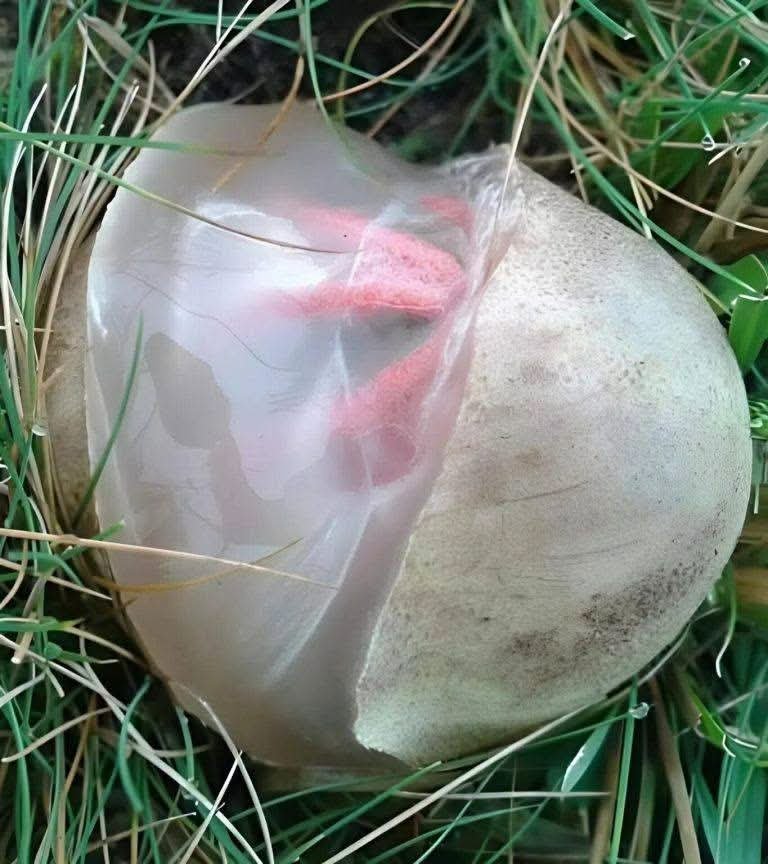
It looked like a strange, pale egg-shaped object lying on the ground.
But when I looked closer, I could see something reddish-pink developing inside it.
What was it?
After taking a closer look, the object appeared to be the egg stage of a stinkhorn mushroom, possibly one of the red or cage-type stinkhorns.
Stinkhorns are fascinating fungi because they can look completely different depending on their stage of development. Before the mushroom emerges, it can resemble a small white or grayish egg buried in grass, mulch, soil, or decaying plant material.
As it matures, the outer layer can split open and reveal the strange-looking mushroom inside.
And that’s when the smell becomes the biggest clue.
Why does it smell so terrible?
The unpleasant odor is one of the most recognizable characteristics of stinkhorn mushrooms.
The mature fungus produces a foul-smelling, slimy material containing its spores. The smell can resemble rotting meat or decaying organic matter.
As disgusting as it sounds, there’s a reason for it.
The odor attracts flies and other insects. When insects land on the fungus, spores can stick to their bodies and be carried to other locations, helping the mushroom reproduce.
So what smells like something has died in your garden may actually be a mushroom using insects as its delivery system!
Is it dangerous?
Finding a stinkhorn in your garden does not automatically mean that your garden is contaminated or that the mushroom is releasing a dangerous poison into the air.
However, because mushroom identification from a photograph can be uncertain, you should never eat a wild mushroom based only on an online identification.
It’s also best to avoid touching unknown fungi unnecessarily, especially if children or pets may be tempted to investigate them.
If the smell is extremely strong, simply ventilating the area and removing the mushroom with gloves or a tool can help. You can also leave it alone if it is not causing a problem—the fungus is generally part of the natural decomposition process.
Why did it suddenly appear?
Stinkhorns often appear when conditions are favorable, particularly when there is plenty of moisture and decaying organic material.
They may seem to appear overnight because much of the fungal organism exists underground or within organic matter before the visible mushroom develops.
The strange “egg” you see is essentially an early stage of the fungus.
The strange thing about nature
At first glance, this discovery might look like something from a horror movie.
A pale egg buried in the grass.
Something red growing inside it.
And an unmistakable smell of decay.
But nature has an explanation for almost everything.
What looks frightening or mysterious may simply be a fungus completing its life cycle.
If you find something similar in your garden, don’t panic—but don’t eat it either. Take a photo, keep children and pets away from it, and consider having it identified by a local mushroom or fungi expert.
Note: Identification from a single photograph is not always definitive. The specimen shown appears consistent with a stinkhorn in its egg stage, but exact species identification requires closer examination.
To provide the best experiences, we use technologies like cookies to store and/or access device information. Consenting to these technologies will allow us to process data such as browsing behavior or unique IDs on this site. Not consenting or withdrawing consent, may adversely affect certain features and functions.
Functional
Always active
The technical storage or access is strictly necessary for the legitimate purpose of enabling the use of a specific service explicitly requested by the subscriber or user, or for the sole purpose of carrying out the transmission of a communication over an electronic communications network.
Preferences
The technical storage or access is necessary for the legitimate purpose of storing preferences that are not requested by the subscriber or user.
Statistics
The technical storage or access that is used exclusively for statistical purposes.The technical storage or access that is used exclusively for anonymous statistical purposes. Without a subpoena, voluntary compliance on the part of your Internet Service Provider, or additional records from a third party, information stored or retrieved for this purpose alone cannot usually be used to identify you.
Marketing
The technical storage or access is required to create user profiles to send advertising, or to track the user on a website or across several websites for similar marketing purposes.